
Suffolk Parole and Probation Compared
Parole and probation can both place a released Suffolk person under Virginia Department of Corrections supervision, yet they begin in different ways. Probation is imposed by a court, either instead of confinement or after a jail or prison term. Parole is conditional release authorized through the Virginia Parole Board for a person who is legally eligible. In both cases, leaving a cell does not mean the sentence or court case has fully ended.
Virginia abolished discretionary parole for most felony offenses committed on or after January 1, 1995, but the law retains exceptions. Offense date, the sentence, prior commitments, offense category, and special age or juvenile provisions can matter. A person should not be labeled parole eligible from sentence length alone.
| Point | Probation | Parole |
|---|---|---|
| Starting authority | A Virginia court order | A Virginia Parole Board decision for an eligible sentence |
| Relation to custody | May replace or follow confinement | Follows conditional release from confinement |
| Public verification | VADOC locator plus the sentencing court | VADOC locator, Board report, and executed release record |
| End point | Court or VADOC discharge under the governing order | Discharge after the parole term and required process |
- Supervision
- Legal oversight in the community under stated terms.
- Discharge
- The formal end of the custody or supervision authority at issue.
- Absconder
- A supervisee alleged to have stopped reporting or left supervision without authorization.
- Detainer
- A request or notice from another authority that may affect custody or release.
Check Suffolk Post-Release Supervision
The first public source is the VADOC Inmate and Supervisee Locator. Its scope includes probationers and parolees supervised by district offices, along with people in VADOC institutions, institutional hospitals, Community Corrections Alternative Program placements, and some people held in local or regional jails under VADOC authority. That broad scope is useful, but it also means a match must be read by status and location.
- Enter the first three letters of the first name and the complete last name, or enter the seven-digit DOC number. Optional filters include location, race, gender, and age range.
- Accept the locator notice, complete the CAPTCHA, and compare the available identity details. Do not rely on a same-name match without another identifier.
- Read the result for current custody or active community supervision. Save the retrieval date because VADOC says the locator updates daily and may contain inaccurate or outdated information.
- Use the VADOC office directory to identify the district that serves the relevant area. Do not assume the nearest office supervises every person who lives nearby.
- Compare the locator with the sentencing court record. The court supplies the probation order, sentence, suspended time, and later revocation entries, while VADOC supplies the active-supervision view.
A person fully discharged from VADOC authority may no longer be available through the public locator. The official source does not promise a permanent archive of all former supervisees. If the result is absent or unclear, use a focused VADOC records request and the correct Virginia court record instead of concluding that supervision ended.
For the full custody and court sequence before supervision starts, the Suffolk released-inmate search separates the WTRJ event, court order, and state record.
Note: Record the source and check time so a later database change does not erase the context of the first result.
Suffolk District 6 Supervision Office
The official District 6 resource directory says VADOC Probation and Parole District 6 serves the City of Suffolk, all of Isle of Wight County, and the Town of Smithfield. The geographic listing helps route a general office-procedure question. It does not promise that every person found in Suffolk is assigned to District 6, and the public directory does not expose a person's officer or check-in instructions.
VADOC Probation and Parole District 6
425 West Washington Street, Suite 5
Suffolk, VA 23434
Phone: 757-925-2278
Area served: Suffolk, Isle of Wight, and Smithfield
The office is the local route for current public procedures. A caller should ask what public channel can confirm the status at issue, not request protected case details. The difference matters because the jail's Suffolk address, a Suffolk court case, a Suffolk home address, and a District 6 assignment are four distinct facts.
The official directory view helps readers locate the office before making contact. The VADOC facilities and offices listing is shown below as captured for this project.
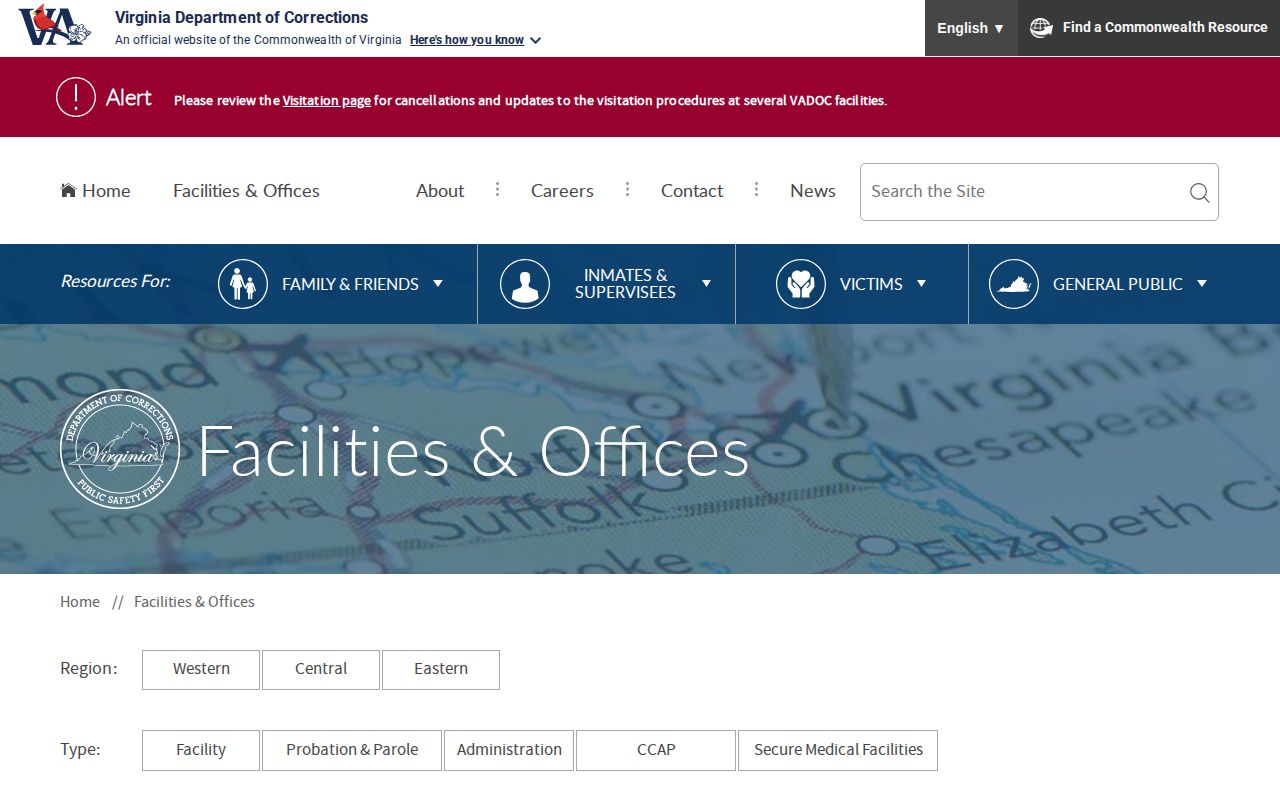
The listing should be checked again before travel because agency contacts and office procedures can change.
Suffolk Supervision Violations and Warrants
Conditions of probation or parole come from the governing order and supervision process. An alleged breach can lead to review, a court proceeding, a Parole Board process, or return to custody. It should not be recast as a new release event. Likewise, a parole grant or probation order does not erase an unresolved detainer, another sentence, or a warrant held by another authority.
No Suffolk-specific public absconder list was identified in the research. Failure to find a person in the VADOC locator does not establish that the person absconded, and a social-media claim is not warrant proof. Verify a warrant through an authorized court or law-enforcement channel. Verify active supervision through VADOC. If a court docket lists a violation or revocation filing, report the entry as a legal proceeding until the outcome and custody effect are confirmed.
Suffolk Parole Decisions and Release
The Virginia Parole Board public-meetings page is limited. Since July 1, 2024, a public meeting is held for final deliberation and vote when the Board is inclined to grant discretionary parole or geriatric conditional release. Agendas are posted at least three working days ahead, and minutes are archived. The Board warns that not every parole-eligible person receives a public meeting.
The Board's monthly parole decision reports list actions by month and year, but decisions are not posted until the end of the following month so notice duties can occur. A listed grant, denial, deferment, rescission, or other action must be stated as that action. Even a grant does not prove that the person left a facility that day. Final processing, conditions, detainers, and other sentences can intervene.
Traditional parole eligibility under Virginia Code § 53.1-151 depends on prior commitments and several statutory limits. Section 53.1-165.1 ended parole for most felony offenses committed from the 1995 cutoff onward, subject to current exceptions. The Board report is thus a decision archive, not a formula calculator or live Suffolk release list.
Note: Confirm physical departure through VADOC custody records before describing a favorable Board action as a release.
How Suffolk Supervision Ends
Physical release, active supervision, and discharge are separate milestones. A probationer may have served the jail portion of a sentence but remain bound by the court's probation order. A parolee has left confinement conditionally while remaining under state authority. Full discharge requires the governing term and formal process to end, not merely the person's disappearance from a public search.
VADOC release documents provide stronger evidence than an earlier projected date. At state-facility release, VADOC describes an Order of Release, Conditions of Probation or Parole, or a notification-of-release letter that is reviewed and signed as applicable. The locator may continue to show a person who has moved from custody to active supervision. After full discharge, a scoped VADOC record and court history may be needed because permanent public-locator retention is not documented.
Virginia public-record law is not a promise that every supervision file will be open. Detailed imprisonment, probation, parole, and pretrial-service records may fall within discretionary exclusions. Sealed, expunged, juvenile, medical, victim, investigative, and security-sensitive information can also be restricted. A precise request for a discharge date or public order is more sound than a demand for a complete case file.
Suffolk Release Property and Balances
Post-release supervision questions often arise at the same time as practical release tasks. Western Tidewater Regional Jail publishes separate procedures for property and remaining account funds. These rules are evidence of WTRJ's local release process, not terms imposed by District 6, and they should not be confused with probation or parole conditions.
Under the WTRJ inmate property procedure, property pickup is available from 8 a.m. to 3 p.m. on weekdays unless an appointment is arranged through the Property Department at 757-942-0545. Usually the person held must collect the property, unless an inmate request form authorizes another person. Released account balances are handled at the Administration Office or Main Lobby from 8 a.m. to 3:45 p.m. on weekdays, excluding holidays or special events. Questions about those balances go to 757-942-0530.
WTRJ says released balances are generally issued by debit card, while balances under $25 are paid in cash. A transfer follows a different track: the person's funds are mailed to the receiving facility, with a special federal placement process. That distinction can help frame the next question. A mailed balance may reflect continued custody after transfer, while a lobby pickup concerns a local release process. Confirm the current procedure directly before relying on it.
Note: WTRJ property and money rules do not identify whether a person is on probation, parole, or fully discharged.