
Suffolk Projected and Actual Release
A projected release date is an “as of” calculation based on the sentence and information known to the responsible authority. An actual release is an executed custody event. The dates may eventually match, but a future date in a locator cannot establish that processing finished, every hold cleared, or the person entered the community.
Suffolk is an independent city, not a county. The local custody source is the regional WTRJ, while the sentence authority may be local, state, or federal.
Pretrial custody requires a different question. A person held at Western Tidewater Regional Jail before judgment may have a bond condition or later hearing, yet no fixed sentence-based departure date. Court action, the ability to meet bond terms, a new order, or another custodian's detainer can control what happens next. A sentenced person can have a computed date, but first identify whether WTRJ or VADOC owns the calculation.
- Projected date
- A current calculation that can change as sentence data and credits change.
- Actual release
- The recorded event when a custodian releases or transfers the person.
- Discharge
- The formal end of the authority at issue, which may occur after physical release.
- Transfer
- Departure from one facility into another custodian's control.
Find a Suffolk Projected Release Date
Start with the sentence and custody authority, not with a percentage. The VADOC Inmate and Supervisee Locator provides location and release-date information for people in VADOC custody or active supervision. It also covers some people in local or regional jails under VADOC authority, so a WTRJ location does not always mean the date was computed locally.
- Confirm the person's identity, booking or DOC number, sentencing court, sentence date, and whether the case is pretrial or sentenced.
- For a state-responsible term, search by the first three letters of the first name and full last name, or by the seven-digit DOC number. Complete the VADOC disclaimer and CAPTCHA.
- Read any displayed future release information as projected. Save the retrieval date and compare all identity and location fields.
- For a short local sentence, contact WTRJ or the responsible local record custodian and review the court sentencing order. Ask which authority owns the computation.
- If the date is absent or disputed, make a scoped written request for the projected parole-eligibility, mandatory-parole, or good-time release date that can lawfully be disclosed as of the inquiry.
- When the date arrives, confirm the executed release or transfer record and check the destination. Do not rely on the old projection alone.
VADOC states that the locator may be inaccurate or outdated and updates daily. Its public materials do not promise that a person fully discharged from all VADOC authority will remain searchable forever. Older or missing information may require an authorized records route and the court case. The broader Suffolk release search explains how those records fit together.
Note: A WTRJ address identifies the physical jail, not necessarily the sentence authority or the locality of the underlying case.
Virginia Credits in Suffolk Release Dates
Virginia uses more than one time-credit framework. Good Conduct Allowance, or GCA, generally concerns felony offenses committed before January 1, 1995 and misdemeanor offenses committed before July 1, 2008. VADOC describes GCA earning from zero to 30 days for each 30 days served, depending on class. These parole-era calculations should not be mixed with the later Earned Sentence Credit framework.
Virginia Code § 53.1-202.2 permits sentence credits for qualifying felony sentences based on offenses committed on or after January 1, 1995. One credit deducts one day. Under § 53.1-202.3, enumerated restricted offense categories have a maximum rate of 4.5 days per 30 days served. Other eligible offenses can earn through Levels I through IV at 15, 7.5, 3.5, or zero days per 30 days. Classification is reviewed at least once each year and can change.
VADOC calls restricted cases ESC-1 and describes the maximum as 4.5 days per 30 days. It calls other eligible cases ESC-2, with possible earning up to 15 days per 30 days based on level. The conviction and underlying offense matter, including the underlying offense involved in a probation violation. The highest rate cannot be applied simply because an offense date falls after the 1995 line.
VADOC often describes the restricted or traditional ESC calculation as requiring at least 85% of the term with credits. That shorthand is not universal. Current § 53.1-202.3 permits enhanced credits for some eligible offenses, while restricted offense categories remain capped at the lower rate. Use the offense and current classification, not a blanket multiplication rule.
The official VADOC time-computation page is captured below. It identifies the frameworks and variables used in the release-date process.
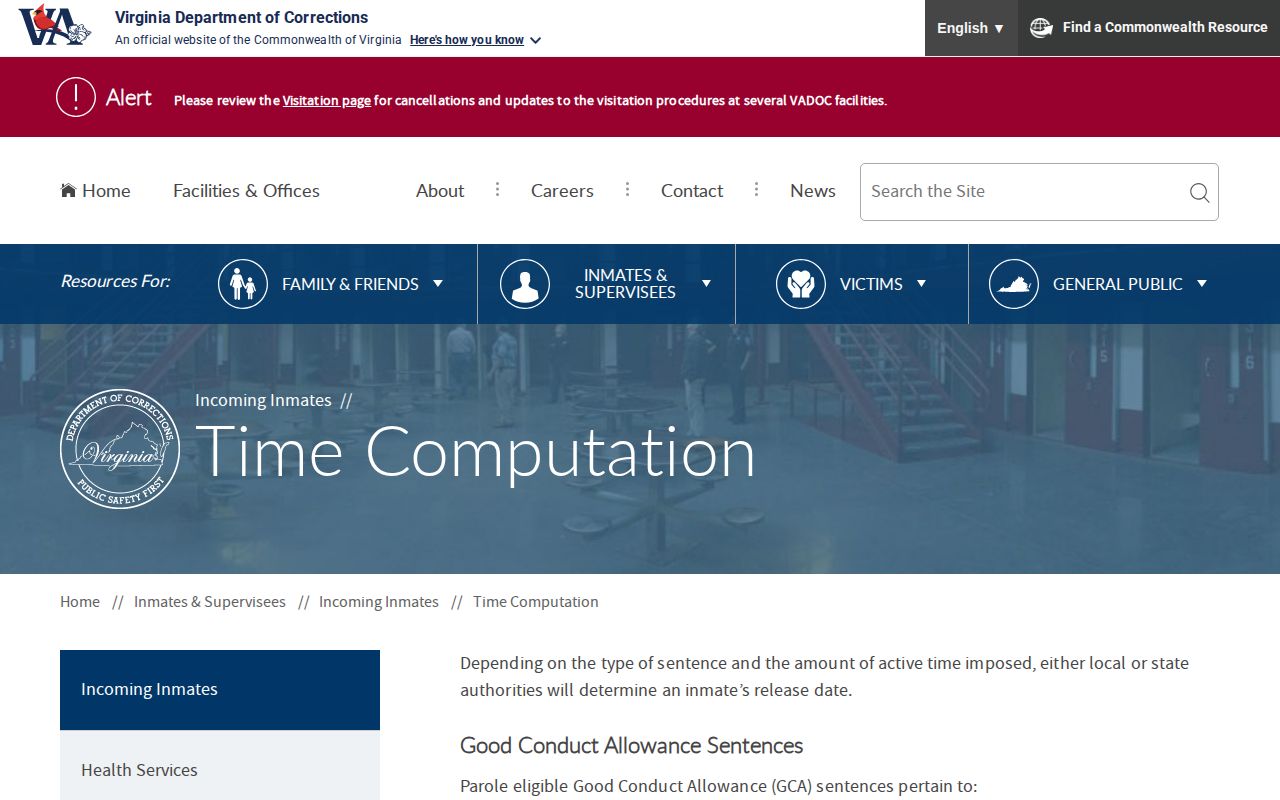
The source should be read with the current statute because offense eligibility and classification control the rate.
Who Computes Suffolk Release Dates
Release-date responsibility changes with the sentence. VADOC calculates dates for active parole-eligible GCA sentences totaling more than 12 months and an active ESC sentence over 12 months. Other local sentences can be computed by the local authority. This is why a person serving time at WTRJ may need a local calculation while another person in the same building is under VADOC authority.
The distinction should be resolved before a date is challenged. Ask the jail or VADOC which authority owns the calculation, then ask for the date as of a stated day and the sentence information on which it rests. The sentencing court supplies the controlling order, but the court docket is not itself the day-to-day sentence computation.
| Situation | Primary date source | Needed check |
|---|---|---|
| Pretrial WTRJ custody | Court and WTRJ status | No sentence-based date may exist |
| Short local sentence | WTRJ or local authority | Ask who owns the computation |
| Qualifying state-responsible GCA or ESC term over 12 months | VADOC | Use locator, time computation, and records |
| Federal contract custody | Federal docket, USMS route, or BOP after entry | Do not apply Virginia credit rules |
This sentence-based split is the distinctive Suffolk release-date issue. VADOC Operating Procedure 050.1 addresses release-date disclosure, while Operating Procedure 010.3 describes public-information limits. WTRJ's regional and federal roles make physical location a poor shortcut for determining the responsible calculator.
Why Suffolk Projected Dates Change
VADOC identifies jail credit before reception, sentence type, the total imposed term, earning class, disciplinary offenses, and later events as computation variables. The date can move in either direction as records are corrected or credits are earned, forfeited, or restored. A date is therefore meaningful only with its source and calculation date.
| Factor | Possible effect | Best source |
|---|---|---|
| Jail credit before VADOC reception | Changes time remaining when correctly applied | Sentencing record and VADOC calculation |
| Sentence addition or correction | Changes the controlling term | Court order and records office |
| Credit class review | Changes the rate of future credit earning | VADOC computation record |
| Disciplinary event | May cause forfeiture or alter classification | Responsible corrections authority |
| Detainer or warrant | May prevent community departure or cause transfer | Final records review and receiving authority |
| Court order for continued custody | Can override the expected departure | Issuing court and custodian |
| Uncalculated sentence or processing | Delays or revises the final date | Records staff responsible for release |
VADOC Operating Procedure 050.3 calls for a final records review that addresses unsatisfied warrants or detainers, court orders for continued custody, classification or discipline affecting release, and uncalculated sentences. A clean projected date is not a promise that those final checks are complete.
Suffolk Parole Dates Are Different
Parole eligibility is not a projected release date. Eligibility marks when the legal framework may permit parole consideration. A Virginia Parole Board grant is a decision, while actual release still depends on conditions, records review, other sentences, and detainers. A Board report should therefore be cited as a grant, denial, deferment, rescission, or other listed action, not converted into a physical departure date.
Virginia Code § 53.1-151 contains traditional eligibility rules that vary with prior commitments and statutory exclusions. Section 53.1-165.1 abolished discretionary parole for most felony offenses committed on or after January 1, 1995, while current exceptions remain for specified situations. The offense date, sentence structure, prior commitments, offense category, and any special juvenile or age provision must be reviewed. Sentence length alone cannot resolve eligibility.
The Virginia Parole Board reports are delayed monthly decision records. Publication occurs at the end of the following month so required notifications can take place. The Board public-meetings page is also incomplete as a review calendar because its public deliberations cover grant-inclined discretionary parole or geriatric conditional release cases under the current meeting rule, not every eligible person.
For a Suffolk person, connect the Board action to VADOC custody and supervision records. If release occurs on parole, the person has left confinement conditionally and may appear in the locator as actively supervised. District 6 serves Suffolk, Isle of Wight, and Smithfield, but the public directory does not promise a person-level officer assignment. A later supervision discharge is another date again.
Confirm a Suffolk Actual Release
For a VADOC release, use the department’s facility-release procedure and seek the executed Order of Release, Conditions of Probation or Parole, or notification-of-release letter. VADOC says the applicable document is read or explained, signed and dated, and witnessed by staff. These records and the custody-to-supervision change are stronger than a prior locator projection.
VADOC states that state-facility discharge or parole release occurs by 11:59 p.m. on the release date, weather permitting. That rule should not be applied to Western Tidewater Regional Jail because no matching local timing rule was found. For a WTRJ event, ask for the recorded departure time, whether the event was community release or transfer, and the receiving agency when releasable.
Virginia VINE can support a prospective WTRJ alert, while eligible VADOC victims use NAAVI. The public Suffolk VINELink inmate search explains the local-jail notification flow and the switch to VADOC channels after transfer. An alert still needs record confirmation when the final destination matters.
After release to probation or parole, the VADOC locator can continue to show active supervision and District 6 may be the local office. After full discharge, use a scoped VADOC request and the sentencing court because permanent locator retention is not documented. A written request should state the date of inquiry and ask which projected parole-eligibility, mandatory-parole, or good-time date could be disclosed under current VADOC procedure. Keep the projected date, executed event, destination, and later discharge date as separate fields.
Note: A court release order explains legal authority, but another hold or transfer can prevent immediate community departure.